






Energy Security Rises: Why BESS Is Now a Core Pillar of the Power System
2026-06-24
Driven by global geopolitical tensions and volatility in traditional energy supply chains, energy security has become a core national strategy worldwide. As clean energy such as wind and solar scales up rapidly, the Battery Energy Storage System (BESS) - the key infrastructure for smoothing renewable fluctuations and stabilizing the grid - continues to benefit from stronger policy support and large-scale deployment.
Key Market Data Highlights
• BNEF: global new energy storage installations reach 158 GW / 459 GWh in 2026, up 41% year-on-year.
• Grid-side storage runs over 2,000 hours per year on average; commercial & industrial storage exceeds 8,000 charge/discharge cycles per year.
• PCS must withstand short-duration surges of 3x rated current, placing strict demands on device SOA.
• Industry data: over 32% of early-stage storage failures originate from power-device failure.
• Mainstream storage systems achieve 83%-90% round-trip efficiency, with device losses a primary cause of efficiency loss.
Wind and solar generation are intermittent and volatile. With millisecond-level response, BESS performs five core functions - peak shaving, frequency regulation, voltage support, emergency backup, and microgrid supply - making it an indispensable “stabilizer” for the new power system.
Building on the BMS technical content we shared earlier: the BMS handles cell monitoring, balancing, and safety protection, while the energy switching and power conversion across the entire BESS rely entirely on MOSFETs. From high-voltage pre-charge and main-circuit current carrying to high-frequency PCS switching, a device’s pulse-handling capability, conduction loss, and long-term stability directly determine system efficiency, lifespan, and safety margin.
General-purpose MOSFETs on the market share common weaknesses: a narrow SOA that is easily broken down by surge current, plus parameter drift and increased leakage under prolonged high-temperature operation - leading to circuit faults and higher maintenance costs.

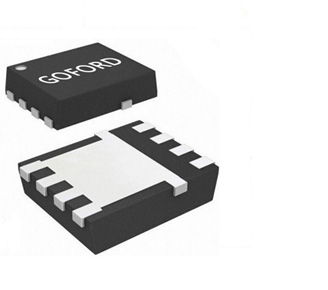
Drawing on its technical experience in BMS applications, Goford has launched a one-stop, storage-dedicated MOSFET solution tailored to the high-voltage, high-current, all-weather operating conditions of BESS, covering three core applications:
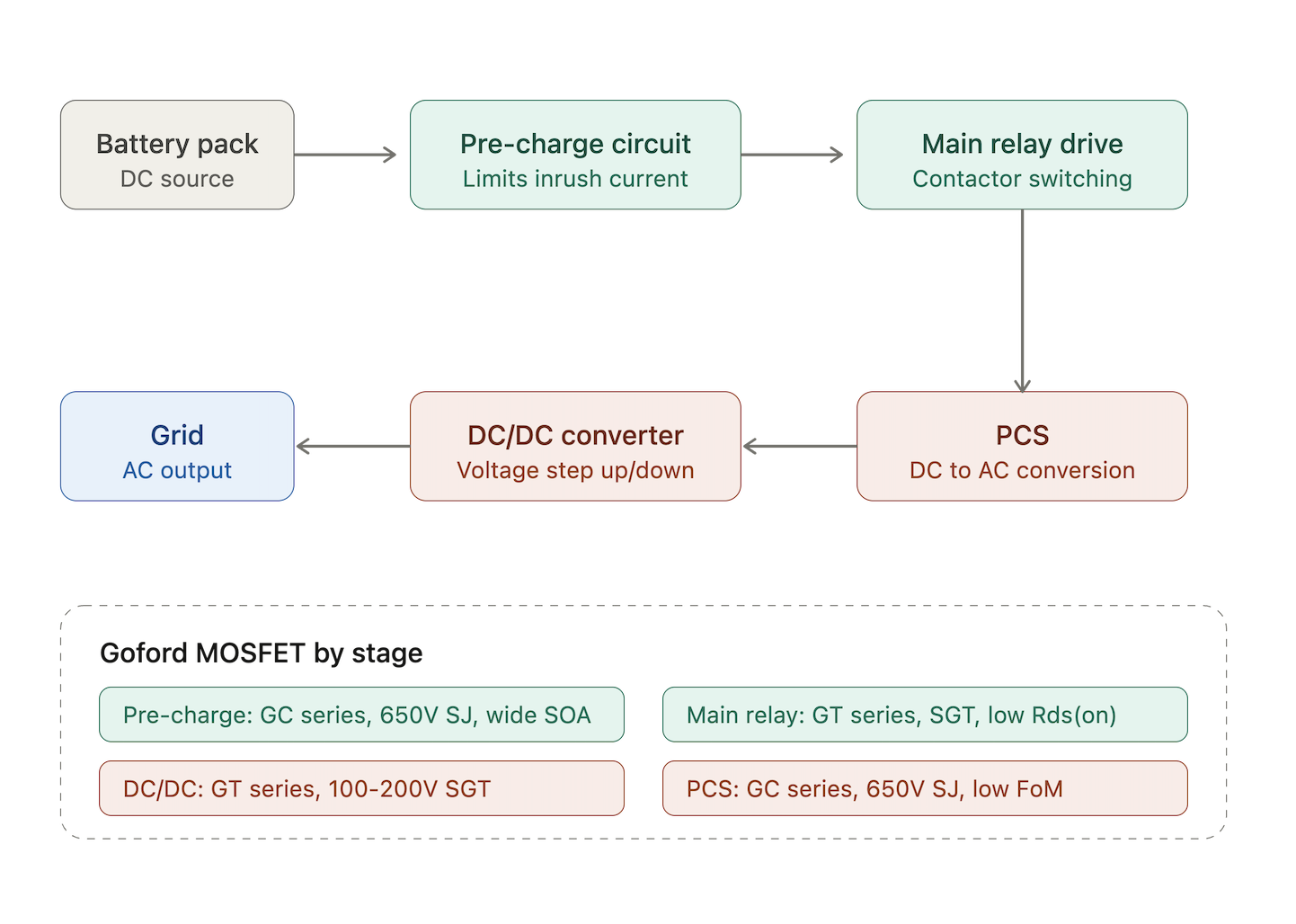
Goford BESS Key Part Numbers & Solutions
1. High-Voltage Pre-charge Circuit | Goford Series
For grid and C&I storage high-voltage power-up scenarios. The wide-SOA process withstands 3x rated surge current; temperature rise is reduced by 15-25°C versus general-purpose devices, making it friendlier to high-density layouts.
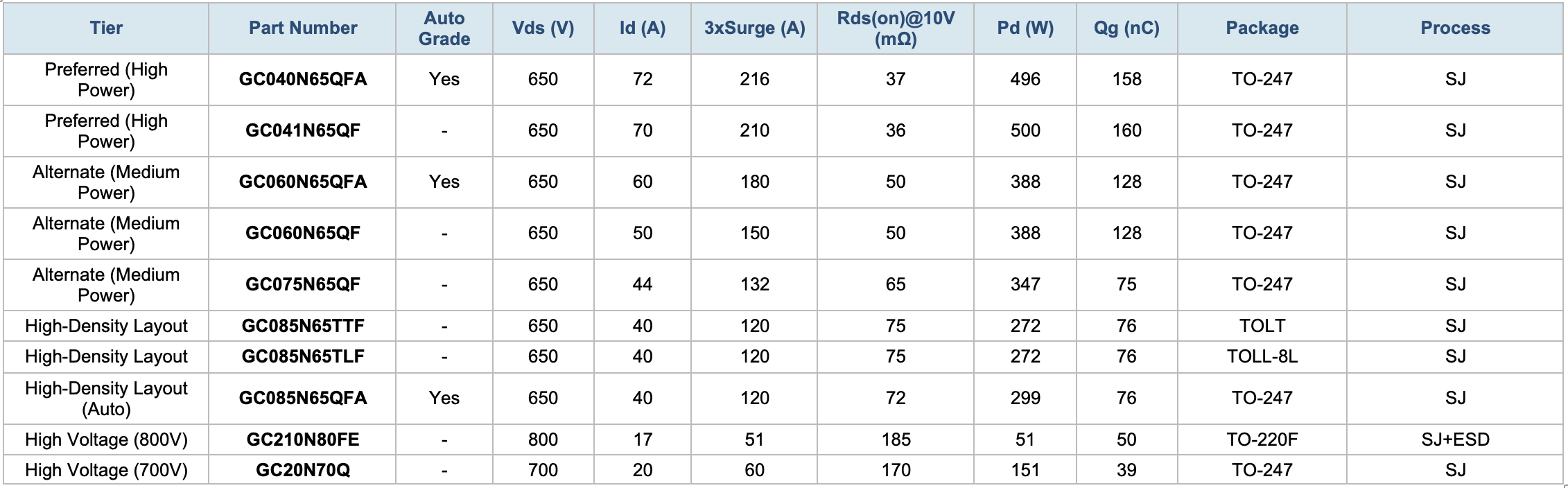
2. Main Relay Drive | Goford Series
For main-circuit contactor drive. Gate leakage current is reduced by 60%+; after 1,000-hour high-temperature reverse-bias (HTRB) testing, Rds(on) drift is below 3%, meeting the 10-year+ long-life requirement of storage systems, with latch-up resistance and false-trigger protection.

3. PCS & Auxiliary Power | Goford Series
For converter and bidirectional DC/DC topologies. Optimized gate charge delivers lower switching loss and suits high-frequency operation, helping system efficiency approach industry benchmarks.

Competition in the storage industry has long evolved into a combined contest of system efficiency, reliability, and total lifecycle cost. Goford stays committed to a scenario-based customization approach, using dedicated MOSFETs to optimize storage-equipment performance from the ground up and support efficient, stable project operation.
In our next post, we will break down the device-selection criteria for each BESS circuit and compare the measured differences between general-purpose and dedicated devices.
 Latest news
-
2026-10-16
From BMS → BESS → IDC → Inverter: The End‑Game of Efficiency Competition is…
-
2026-09-30
Microinverters Are Booming as MLPE and Module-Level Rapid Shutdown Go Mainstream…
-
2026-09-16
GOFORD Semiconductor at Electronica 2026
-
2026-09-01
High-Frequency Inverters 2026: 20kHz+, Miniaturization & SiC Synergy — How to …
-
2026-08-13
Data Center BBU Power: Key MOSFET Selection Criteria & Goford Solutions