
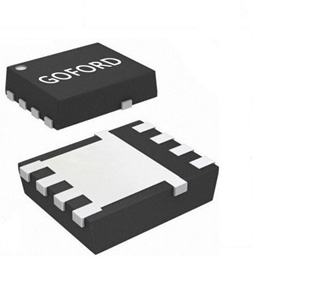






Microinverters Are Booming as MLPE and Module-Level Rapid Shutdown Go Mainstream: Goford's High-Reliability MOSFET Portfolio
2026-09-30
2026 is shaping up to be a breakout year for microinverters. Driven by three converging forces — residential PV, commercial & industrial (C&I) distributed generation, and tightening safety compliance — MLPE (Module-Level Power Electronics) and module-level rapid shutdown are becoming the new standard, fundamentally redefining what we ask of power devices.
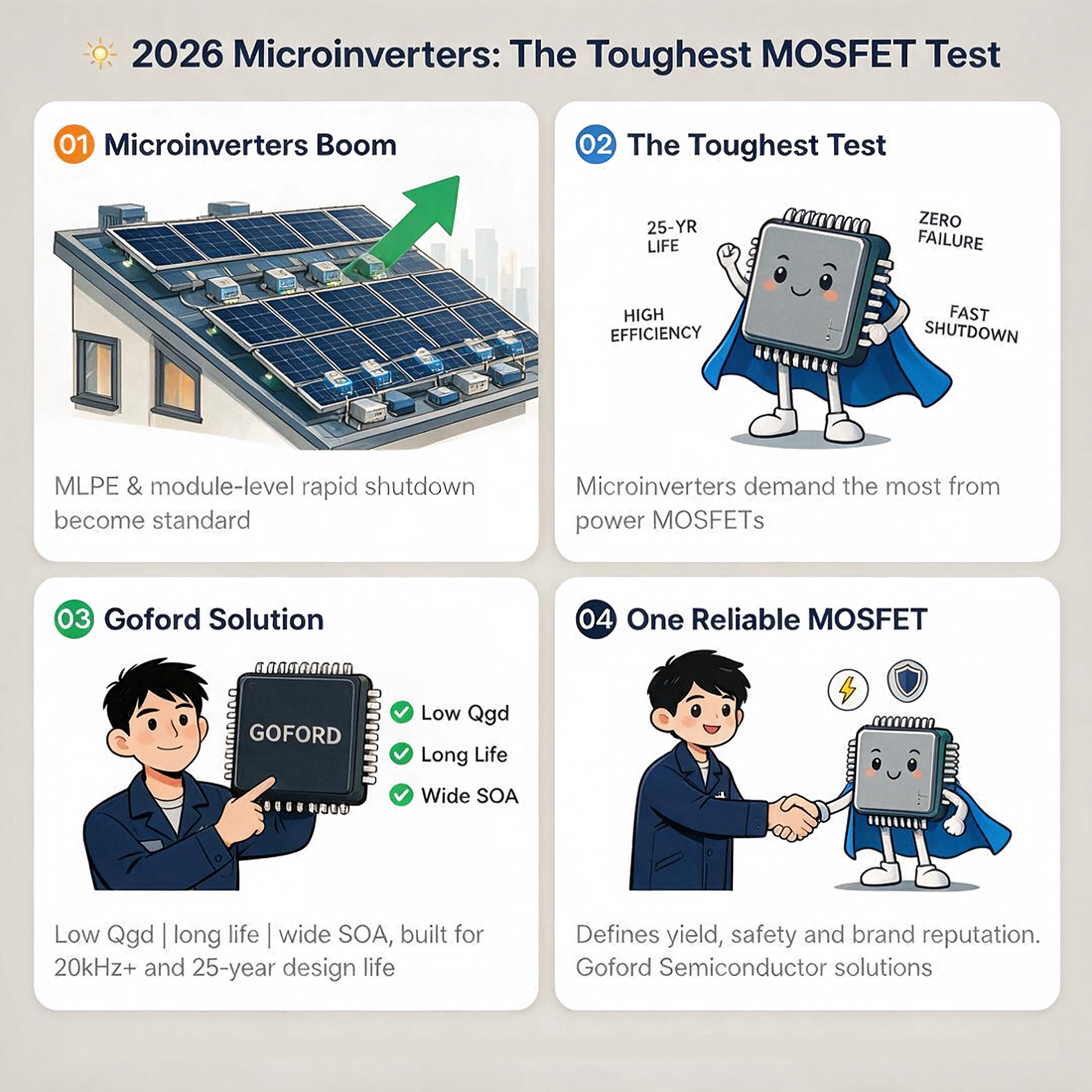
Microinverters place arguably the most demanding requirements on MOSFETs of any application:
1. 25-year service life — outdoor thermal cycling, relentless sun and rain, non-stop operation
2. High reliability — zero-failure tolerance, low parameter drift, aging resistance, humidity resistance
3. High efficiency — compact size, high power density; every watt of loss comes straight off the energy yield
4. Safe shutdown — millisecond-level response that satisfies both grid codes and safety standards
Compared with traditional string inverters, microinverters push MOSFETs even harder on:
● Long-term high-temperature stability (minimal RDS(on) drift over life)
● Ultra-low gate leakage — no false triggering, clean and complete shutdown
● Wide SOA — riding through module-side transients and inrush events
Goford's dedicated portfolio for microinverters and high-frequency inverters:
✅ Low-Qgd, high-frequency-optimized MOSFETs — built for 20 kHz+ topologies, with lower switching losses and higher system efficiency
✅ High-reliability, long-life devices — validated by long-term aging tests; lower leakage, stronger stability, designed for a 25-year service life
✅ Wide SOA, robust surge tolerance — absorbing module-side fluctuations and power-up transients for a safer system
The microinverter race has moved well beyond cost — it's now a deep competition on longevity, efficiency, and safety. The reliability of a single MOSFET directly affects energy yield, safety class, and brand reputation.
PV, microinverter, and distributed energy engineers — let's connect to discuss device selection and design optimization.
 Latest news
-
2026-10-16
From BMS → BESS → IDC → Inverter: The End‑Game of Efficiency Competition is…
-
2026-09-30
Microinverters Are Booming as MLPE and Module-Level Rapid Shutdown Go Mainstream…
-
2026-09-16
GOFORD Semiconductor at Electronica 2026
-
2026-09-01
High-Frequency Inverters 2026: 20kHz+, Miniaturization & SiC Synergy — How to …
-
2026-08-13
Data Center BBU Power: Key MOSFET Selection Criteria & Goford Solutions